Management Turnover as Change Agent

Friday, October 19, 2012

Executive Turnover Looking to Grow After Election


Executive Turnover Looking to Grow After Election

2005-2012 Total Quarterly C-level ChangesJob growth and unemployment remain serious problems for the North American economy.  Executive turnover continues to serve as one of the few positive bright spots within the United States and Canadian economies.  For the last year overall executive turnover has remained high, a huge change from the declining numbers registered in the previous years during the height of the financial crisis.  Unlike growing unemployment numbers, turnover at the top typically portends positive economic growth in the near future.  While executive turnover numbers have moved off of trending highs, they have continued to follow a growth pattern over the last year.

Liberum Research continues to remain optimistic about the impact the growth in executive turnover will represent for the United States and Canadian economies.   For the last number of years through the financial and economic crisis, executive turnover at the top ranks of public companies was extremely low.  Caution rained supreme.  Companies cut budgets and employees but were loath to change top executives unless they absolutely had to. The order of the day was to keep the captains of the ship in place.   For the last year and a half, Liberum Research has seen a real shift in this trend.  Executive turnover overall has continued to rise while overall employment has finally showed signs of some growth.  We expect the employment numbers will continue to improve, while slowly, as we move into the late fall and winter.  Once the election is over, we expect the employment numbers will continue to improve and executive turnover will grow.
Liberum has put together below a nearly eight year quarterly breakdown of executive turnover totals for CEOs, CFOs and C-level executives covering North America. Most of the below quarterly numbers showed continuing declines until the second quarter of 2011.  At this point, the numbers began to reverse themselves.  Turnover at the executive levels of corporate America began to grow.  Companies began again to consider new blood and often looked to change their corporate strategies as kernels of opportunity began to sprout ever so slightly.  Anyone investing in the market must pay special attention to executive turnover both at the top and the middle executive ranks.  Failure to do so, will result in lost opportunities or worse.
Below are three simple graphics outlining the quarterly turnover totals as registered through Liberum’s Management Change Database for 2008 through the third quarter of 2012 for CEO, CFO and overall C-level turnover.

2005-2012 Total Quarterly CFO Changes

Thursday, September 13, 2012

Tepid Job Growth Fails to Stall Executive Turnover


Just as we saw in the previous month of July, executive turnover in North America continues to slow down from the rapid rate we experienced for most of the last year.  The recent slowdown in executive turnover has not been dramatic and we anticipate turnover will begin to grow again as we move into the Fall and Winter months.  Last Friday morning the U.S. Department of Labor’s Bureau of Labor Statistics released its highly anticipated August 2012 Employment Report, The Gallup Organization on September 6, released its unemployment numbers for August and earlier in the week, ADP released its Private Employment Report.  All three reports showed poor progress in job growth and a small reduction in overall unemployment.
The Labor Department’s BLS Report stated,
Total nonfarm payroll employment rose by 96,000 in August, and the unemployment rate edged down to 8.1 percent,…
… The unemployment rate edged down in August to 8.1 percent. Since the beginning of this year, the rate has held in a narrow range of 8.1 to 8.3 percent. The number of unemployed persons, at 12.5 million, was little changed in August.
The latest Gallup Report stated:
U.S. unemployment, as measured by Gallup without seasonal adjustment, is 8.1% for the month of August, down slightly from 8.3% measured in mid-August and 8.2% for the month of July. Gallup’s seasonally adjusted unemployment rate for August is also 8.1%, a slight uptick from 8.0% at the end of July.
These results are based on Gallup Daily tracking interviews, conducted by landline and cell phone, with more than 30,000 Americans throughout the month. Gallup calculates a seasonally adjusted unemployment rate by applying the adjustment factor the government used for the same month in the previous year. The government adjusted its July numbers downward last year, but made no adjustment in August, which accounts for the increase in seasonally adjusted unemployment despite the decline in the unadjusted number.
U.S. unemployment declined significantly during the first part of the year, but August marks the third straight month with little change in the unadjusted number. Gallup’s estimate of adjusted unemployment has increased by 0.3 percentage points since June. Despite the lackluster jobs growth, August’s 2012 unadjusted and adjusted unemployment are each more than a full point lower than they were in August 2011.
According to the August ADP Employment Report:
Employment in the U.S. nonfarm private business sector increased by 201,000 from July to August, on a seasonally adjusted basis. The estimated gain from June to July was revised up from the initial estimate of 163,000 to 173,000.
Employment in the private, service-providing sector expanded 185,000 in August, up from 156,000 in July.  Employment in the private, goods-producing sector added 16,000 jobs in August.  Manufacturing employment rose 3,000, following an increase of 6,000 in July.  Employment on large payrolls—those with 500 or more workers—increased 16,000 and employment on medium payrolls—those with 50 to 499 workers—rose 86,000 in August.
Employment on small payrolls—those with up to 49 workers—rose 99,000 that same period. Of the 86,000 jobs created on medium-sized payrolls, 12,000 jobs were created by the goods producing sector and 74,000 jobs were created by the service-providing sector.
Construction employment rose for the third consecutive month, adding 10,000 jobs, marking the best reading since March.  The financial services sector added 8,000 jobs from July to August, marking the thirteenth consecutive monthly gain.
Here in the United States growing executive turnover remains one of the few bright spots for the United States economy.  While Liberum’s assessment for the future of the U.S. economy is a minority view, we still see hope for growth in the economy and in overall jobs.  For the next few months, Liberum expects to see reasonably robust turnover in the nation’s corporate executive ranks.  Today’s Federal Reserve announcement is another push forward that might help with job growth going forward.
Below is a simple breakdown of the key executive category percentage increases for August 2012 compared with August a year earlier and the previous month of July 2012.  The year to year changes overall were for the first time in nearly a year negative.
  • For August only one of four key categories saw an increase, CEO changes showed no change from a year ago, CFO changes declined 13%, overall C-level (as defined by Liberum Research as board of directors, CEOs, CFOs down to corporate VPs) changes declined 17% while board of director changes increased 131% as compared with August 2011 totals.
  • The month to month change in executive turnover showed consistent increases for all four key areas for July 2012 to August 2012, a positive sign for the future.  CEO changes increased 13%, CFO changes increased 20%, overall C-level changes increased 10% and board of director changes increased 22% respectively.
Below are four graphs illustrating the August sector breakdowns and total turnover changes for CEOs, CFOs, C-level  and Board of Directors.


August 2012 CEO Changes By Sector


August 2012 CFO Changes By Sector


August 2012 C-level Changes By Sector


AUGUST 2012 Board of Director Changes by Sector

Friday, June 22, 2012

May’s Executive Turnover Totals Defy Weak Job Growth

Liberum Research continues to view the American economy in a more positive light than has been seen by the majority of analysts and economic forecasters.  Despite the worrying overall employment numbers and incredibly weak job growth that has been registered of late, Liberum expects these numbers will improve as we move into the late summer and early fall.  We are still very concerned about the severe economic problems in Europe and hope to see a change of strategy by Germany in conjunction with the other large European members to deal with the problems facing Greece, Spain, Italy and Portugal.  If the severe austerity approach of the European Community continues, Liberum will be forced to re-evaluate our assessment but we expect growing pressures will force it to change.

Here in the United States growing executive turnover remains one of the few bright spots for the United States economy.  While our assessment for the future of the U.S. economy is a lone voice, we still see real hope for growth in the economy and in overall jobs.  Last month’s job numbers so far do not jive with our forecast but we still believe there is a real chance for a change in these numbers going forward.  For the next few months, Liberum expects to see reasonably robust turnover in the nation’s corporate executive ranks.  We expect these growing turnover numbers will translate into a slow but steady growth in jobs.

Below is a breakdown of the key executive category percentage increases for May 2012 compared with May a year earlier and the previous month of April 2012.  The year to year changes overall were quite positive while the month over month executive turnover numbers again showed a slowing in the trend but unlike the previous month to month comparison actually showed growth.
  • For May the four key categories saw increases, CEO changes increased 37%, CFO changes increased 75%, overall C-level (as defined by Liberum Research as board of directors, CEOs, CFOs down to corporate VPs) changes increased 25% and board of director changes increased 84% as compared with May 2011 totals.
  • The month to month change in executive turnover showed an increase for all the key areas for April 2012 to May 2012.  CEO changes increased 30%, CFO changes increased 7%, overall C-level changes increased 6% and board of director changes increased 10%.
Below are four  graphical representations of the total executive turnover changes in the month of may for CEOs, CFOs, C-level changes (as defined by Liberum Research) and Board of Director Changes.  The numbers continue to show growth.


May 2012 CFO Changes

May 2012 C-level Changes
May 2012 Board of Director Changes

Tuesday, April 10, 2012

Quarterly Executive Turnover Continues on a Tear

What a difference a year makes. For the last number of years, executive turnover at the top ranks of public companies was extremely low. As the nation and the world faced the huge financial crisis in 2008 and thereafter, companies were loath to change executives unless absolutely necessary but were often eager to layoff off general employees. For the last 12 – 14 months, Liberum Research has seen a real shift in the trend. Executive turnover overall has continued to rise while overall employment has finally showed signs, while tepid, of growth. Last week, ADP which tracks overall private employment, announced more positive news for the month of March. According to ADP’s latest Employment Report:
Employment in the U.S. nonfarm private business sector increased by 209,000 from February to March on a seasonally adjusted basis. Estimated gains for previous months were revised higher; the gain from December to January was revised up by 9,000 to 182,000, and the gain from January to February was revised up by 14,000 to 230,000. Employment in the private, service-providing sector increased 164,000 in March, after rising a revised 183,000 in February. Employment in the private, goods-producing sector rose 45,000 in March. Manufacturing employment added 23,000 jobs.
Later in that same week, the U.S.Labor Department released its employment numbers and to most analysts’ surprise, they were less than encouraging. Liberum expects the numbers will be revised upward but the lower than expected totals were a cause for some concern. According to the Bureau of Labor Statistics‘ employment numbers for March released on Friday, April 6,

Nonfarm payroll employment rose by 120,000 in March, and the unemployment rate was little changed at 8.2 percent, the U.S. Bureau of Labor Statistics reported today. Employment rose in manufacturing, food services and drinking places, and health care, but was down in retail trade.

Liberum has put together below a six plus year quarterly breakdown of executive turnover totals for CEOs, CFOs and C-level executives covering North America. Most of the below quarterly numbers showed continuing declines until the second quater of 2011. At this point, the numbers began to reverse themselves. Turnover at the executive levels of corporate America began to grow. Companies began again to consider new blood and often looked to change their corporate strategies as kernels of opportunity began to sprout ever so slightly. We also saw a number of major companies change leadership after major declines in revenues and/or profits.
GRAPHIC REPRESENTATION OF QUARTERLY KEY EXECUTIVE TURNOVER TOTALS
2005 – 2012


Monday, February 13, 2012

January Executive Turnover Continues to Grow

Liberum’s January 2012 executive turnover data has continued to show growing turnover within the executive ranks similar to what we have seen for most of the last ten months. January has actually seen a continuing positive trend with regard to the number of people filing new unemployment claims and, even more significantly, the economy has actually generated more jobs. On Friday February 3, the United States Department of Labor’s Bureau of Labor Statistics (BLS) announced its latest employment numbers. The news overall was pretty good, considering what most analysts had expected. The official unemployment rate dropped a modest 0.2% down to 8.3%. According to the BLS’s official Employment Situation Summary released Friday morning:

Total nonfarm payroll employment rose by 243,000 in January, and the unemployment rate decreased to 8.3 percent, the U.S. Bureau of Labor Statistics reported today. Job growth was widespread in the private sector, with large employment gains in professional and business services, leisure and hospitality, and manufacturing. Government employment changed little over the month.

The unemployment rate declined by 0.2 percentage point in January to 8.3 percent; the rate has fallen by 0.8 point since August. The number of unemployed persons declined to 12.8 million in January.

Liberum expects this trend will continue, while ever so slowly.

Below is a breakdown of the key executive category percentage increases for January 2012 compared with January a year earlier and the previous month of December 2011 and here again, the number totals were quite positive.

  • For January all four key categories saw increases, CEO changes increased a huge 191%, CFO changes increased 144%, overall C-level (as defined by Liberum Research as board of directors, CEOs, CFOs down to corporate VPs) changes increased 107% and board of director changes increased 11% as compared with January 2011 totals.
  • The month to month change in executive turnover was much smaller for December 2011 to January 2012. CEO changes increased 4%, CFO changes increased 21%, overall C-level changes increased 11% while board of director changes declined 5%.

Below are the key statistics for executive turnover for the month of January followed by graphs outlining the total turnover numbers for each key category.

JANUARY 2012 MANAGEMENT CHANGE STATISTICS

C-LEVEL MANAGEMENT CHANGE STATISTICS
GRAND TOTAL – 1855

TOP INDUSTRY SECTORS

> Energy – 175
> Drugs/Biotech – 146
> Banking – 145

JANUARY 2012 CEO CHANGE STATISTICS
GRAND TOTAL – 247

TOP INDUSTRY SECTORS

> Energy – 27
> Banking – 24
> Drugs/Biotech – 23

JANUARY 2012 CFO CHANGE STATISTICS
GRAND TOTAL – 207

TOP INDUSTRY SECTORS

> Energy – 19
> Drugs/Biotech – 18
> Metals/Mining – 15

JANUARY 2012 BOARD OF DIRECTOR CHANGE STATISTICS
GRAND TOTAL – 160

TOP INDUSTRY SECTORS

> Banking – 26
> Energy – 21
> Drugs/Biotech – 16

Tuesday, December 13, 2011

November Continues Growth Trend in Executive Turnover

Liberum’s executive turnover data for the month of November has continued to show growing turnover within the executive ranks similar to what we have seen for most of previous months this year. This trend was a complete reversal of what we saw for the previous two years. November’s increase in executive turnover took place while we saw a positive trend with regard to the number of people filing new unemployment claims and, even more significantly, the economy has actually generated more jobs. This is not say we are out of the woods with regard to overall employment and the economy but more positive employment signs continue to show up. In early December, the United States Department of Labor’s Bureau of Labor Statistics (BLS) announced the latest employment numbers. The official unemployment rate dropped a modest 0.4% down to 8.6%, the lowest rate since March 2009. There still remains 13.3 million people unemployed a seriously high number. The modest gain in employment is further tempered by the fact that according to BLS 315,000 people had given up looking for work. Even las t week we saw another drop in the number of people applying for unemployment.

Below Liberum has outlined in graphical format a November breakdown for CEO, CFO and overall C-level related turnover.

C-LEVEL RELATED CHANGES FOR NOVEMBER

Breakdown of November C-level changes includes internal, joingin from outside, leaving without clear explanation, promoted from within, resigned retired and terminated

CEO RELATED CHANGES FOR NOVEMBER

Breakdown of November CEO changes includes internal, joining from outside, leaving without clear explanation, promoted from within, resigned retired and terminated

CFO RELATED CHANGES FOR NOVEMBER

Breakdown of November CFO changes includes internal, joining from outside, leaving without clear explanation, promoted from within, resigned retired and terminated

For the month of November, CEO changes increased a huge 125%, CFO changes increased 111%, overall C-level (as defined by Liberum Research as board of directors, CEOs, CFOs down to corporate VPs) changes increased 94% while board of director changes declined 11% as compared with November 2010 totals. The month to month change in executive turnover on the other hand was negative for November 2011 when compared with October 2011 totals. CEO changes declined 12%, CFO changes declined 15%, overall C-level changes declined a mere 2% and board of director changes declined only 3%. Liberum expects the fourth quater of 2011 to show an increase over the same quater in 2010. Stay tuned.

Thursday, August 25, 2011

AMD Finally Fills CEO Post


After over six months of searching for a new CEO to replace former CEO Dirk Meyer, who resigned back in January and had been rumored to be forced out due to his lack of vision, AMD NASDAQ has finally chosen a new CEO. AMD has selected Rory Read, Lenovo’s President and Chief Operating Officer to lead the firm as its new CEO. AMD’s search for a new CEO has been painfully difficult. The semiconductor firm, which has managed somewhat of a resurgence while under the direction of former CEO, Dirk Meyer, and its current interim CEO, Thomas Seifert still has a difficult road to true recovery and long term survival. While AMD has been reasonably successful in the PC world as second banana to I

ntel, the company has very far to go with regard to processors for mobile phones and tablets the current growth generators. AMD has been through rough waters for sometime and many potential candidates have chosen not to be considered for the CEO position. Throughout the CEO search process a number of potential candidate names have been rumored under consideration including Tim Cook, Apple’s soon to be new CEO after Steve Jobs made his dramatic resignation, Mark Hurd, Oracle’s co-president and former HP CEO, Pat Gelsinger the Carlyle Group Chief Operating Officer and others have all apparently turned down AMD.

Read’s selection to run AMD is a positive, the company has finally found someone to take on the challenge. While Read has an impressive background while at Lenovo as well as significant leadership work while working at IBM for twenty three years he has a monumental task ahead of him. AMD’s press release announcement contained a terrific spin on Read’s selection. we will just have to wait and see. At least company now has a new leader and get to work on addressing many of the firm’s future needs and strategic direction.

Investors need to closely monitor what Read does upon taking the reigns and going forward.

Tuesday, July 19, 2011

Second Quarter Executive Turnover Shows Real Growth

With the end of the second quarter, the United States economy appears to have turned a major corner in relation to executive turnover. Executive turnover, as tracked by Liberum, has seen a continuing jump in the totals for June 2011 and the second quarter. The jump in turnover has been apparent when second quarter was compared with the same quarter in 2010 as well as in relation to the previous first quarter of 2011. The continuing jump in executive turnover appears to be at odds again with the level of employment and unemployment in the United States economy. Troubling signs for overall employment continue to haunt the U.S. economy as the recovery continues to limp along.

Now that we are finally seeing changes at the top of corporations, hope can increase that companies will finally begin to start hiring again. Liberum contends that the slow level of executive turnover over the previous number of years related to the reluctance corporate boards and top executives had to change top leadership during tough economic times except in situations where the firm in question performed so poorly that a top executive change was necessary or if a major strategic change change in strategy was needed. As we moved into 2011, we finally saw the level of unemployment bottom out.

Liberum expects that if the economy manages to recover, even ever so slightly, the level of executive turnover will continue to rise. Both the pent up demand for new top executives and the possibilities for new job opportunities will account for growing executive turnover. Also boards are expected to be more willing to make changes as the economy continues to move in a positive direction especially if the debt ceiling problem is resolved, even temporarily.

Below are three simple graphics outlining the quarterly management changes as registered through Liberum’s Management Change Database for 2008 through 2011 (second quarter) for CEO, CFO and overall C-level turnover. The first two quarters of 2011 dramatically illustrate the reversal in trends we have seen for a number of years. Executive turnover is again in the ascendancy. We expect this trend to continue unless the economy encounters some kind of major shock, lack of agreement on the debt ceiling, for example, a major sovereign bankruptcy (Greece) or something totally unforeseen.


Friday, June 24, 2011

Newell Rubbermaid Makes Wise Choice


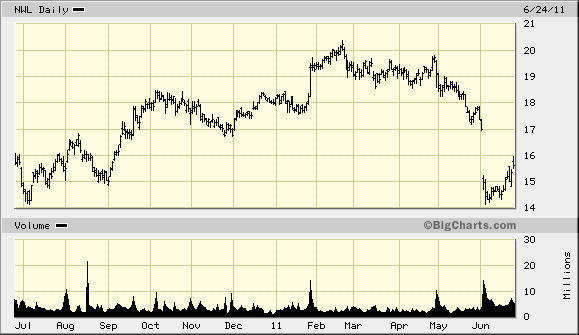
Newell Rubbermaid NWL (NYSE), the consumer products manufacturer, yesterday announced the selection of Michael Polk as its new CEO. Polk, currently the president of global foods, home and personal care at Unilever is also a member of Newell’s board ofdirectors. Polk will succeed Mark Ketchum who was selected as Newell’s CEO back in 2005. Ketchum back in January of this year announced his intention to retire. The firm hired a search firm to find a new CEO. Wisely, the firm selected a seasoned executive familiar with their business but with experience outside the firm. Polk, who is fifty years old comes in as CEO as Newell has failed to live up to expectations. While he has a difficult task ahead of him, he has both the skills and the drive to help find ways to make the firm perform better going forward.

Earlier today, thestreet.com’s Miriam wrote a piece expressing concern about expectations the new CEO will create about the firm. Remer wrote,

Jefferies analyst Douglas Lane cautioned that Polk will have his work cut out for him in managing expectations after Newell Rubbermaid recently trimmed its full-year outlook. The guidance revision came, in part, because of soft demand in some of Newell Rubbermaid’s consumer product categories such as baby and parenting.

I am not nearly as sanguine as the Jefferies’ analyst quoted. Polk has a real opportunity to shine in his new position. Stay tuned.


New updated article 7/12/11 – Globe and Mail’s David Milstead – Get ready for a nice bounce in Rubbermaid shares

Wednesday, May 11, 2011

Cisco CEO Can He and Should He Survive?


Cisco Systems, Inc. CSCO (NASDAQ), the one-time darling of investors, finds itself in difficulty. The company designs, manufactures, and sells Internet protocol (IP)-based networking and other products related to the communications and information technology industry worldwide. Back in early April, the company’s well known CEO, John Chambers, was forced to admit the company had problems. According to a story in BizJournals, Chambers wrote a memo in early April to his employees in which he stated,

“We have disappointed our investors and we have confused our employees. Bottom line, we have lost some of the credibility that is foundational to Cisco’s success – and we must earn it back.”
Chambers went on to state,
… he will “address with surgical precision what we need to fix in our portfolio.”
The growing problems facing Cisco were made more problematic yesterday, when Microsoft announced the purchase of Skype. While most analysts have focused on the problems Microsoft’s acquisition could mean for Google and Apple, Cisco is also at severe disadvantage from this latest acquisition and is in a weaker position than the others to respond. While Microsoft has not shown great success in the past when it came to telecom acquisitions and the ultimate execution or integration of the acquisitions, the purchase of Skype was a brilliant move. If Microsoft can make the acquisition work, it will be beneficial in many ways for the firm and may even make its arrangement with Nokia a real winner going forward. Cisco on the other hand, only has more competition and a greater need for righting its ship.

Investors can expect tremendous pressure on Chambers going forward. His reign at Cisco seems more and more tentative as we move forward. He needs to make changes in the company and fast. Stay tuned.